


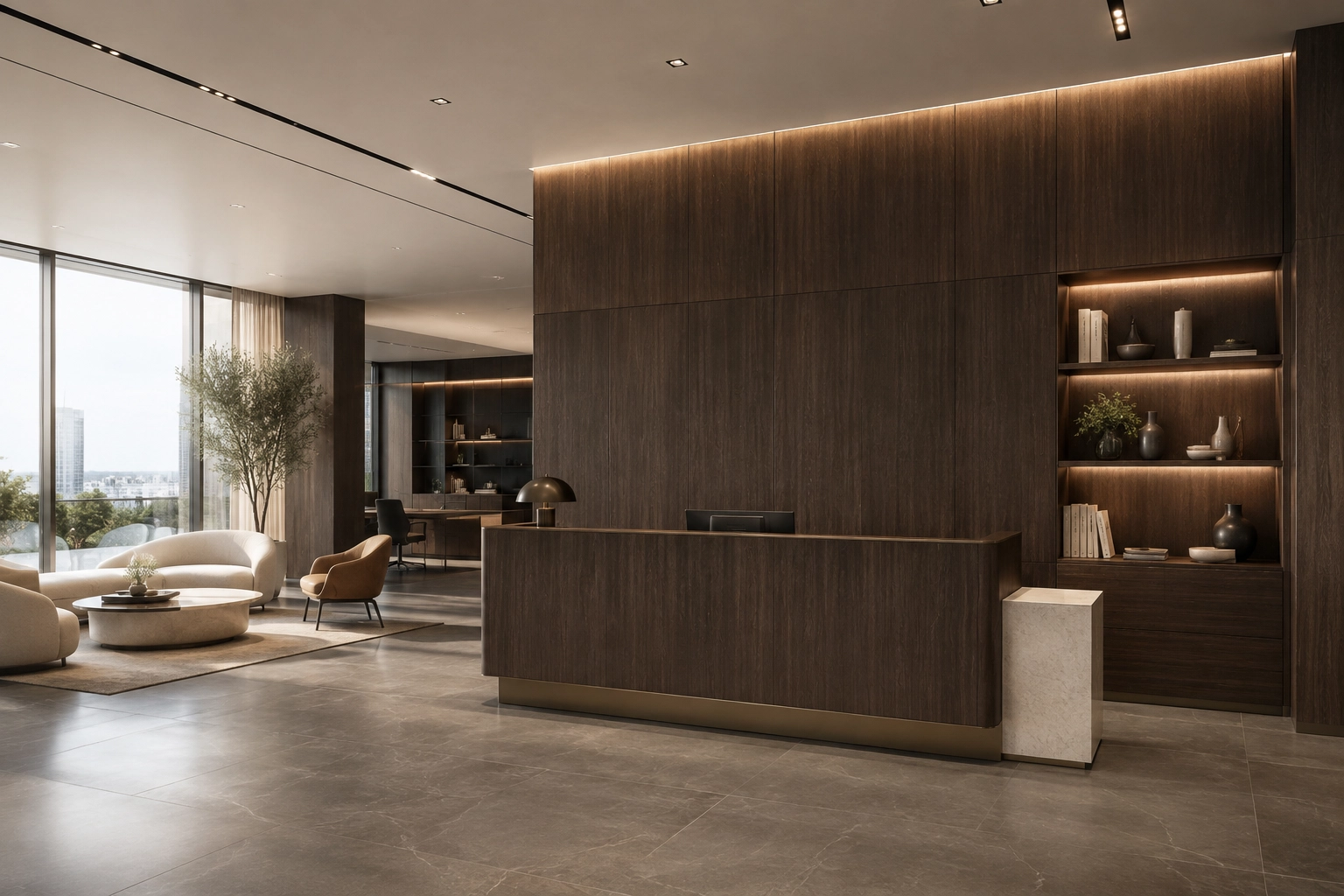
Decorative Surfaces for Hospitality, Workplace and Retail Interiors
Commercial interiors need a repeatable material language
Hospitality, workplace and retail environments have different functions, but they share one important characteristic.
Selected surfaces often appear repeatedly across cabinetry, furniture, wall features, counters, storage and custom joinery.
The material palette therefore needs to work as a system rather than as a collection of individual finishes.
Match the surface to the experience
Hospitality interiors often use material to establish atmosphere.
Warm wood expressions can make guest rooms and public spaces feel more welcoming. Deeper tones can introduce visual weight and formality. Lighter surfaces may support quieter and more contemporary environments.
Workplace interiors require a different balance.
Commercial material selection works best when the surface supports both the identity of the space and the way it will be used.
General work areas may benefit from restrained surfaces that create consistency across larger areas, while reception spaces, boardrooms and executive environments can use richer materials to establish hierarchy.
Retail and F&B interiors often need stronger visual identity. Counters, shelving, display systems and wall elements become part of the customer’s experience of the brand.
In these environments, consistency can be more effective than complexity. Repeating a controlled palette across different elements often creates greater recognition than introducing a new surface at every opportunity.
Coordinate materials across multiple applications
Commercial interiors rarely rely on one material alone.
Decorative wood surfaces may need to work beside flooring, stone, metals, fabrics and other architectural finishes. Establishing a hierarchy helps prevent the interior from becoming visually fragmented.
Visualization is useful before sampling because it allows selected surfaces to be reviewed across a larger area.
A timber that works well on a small furniture element may behave very differently when repeated across an entire wall of hotel wardrobes, an office reception desk or a retail display system.
Connect specification with project requirements early
Commercial projects operate within quantities, programmes and approval processes.
Material decisions should therefore connect to physical product information, samples and commercial requirements before they become difficult to change.
Early coordination between the design team, supplier and fabricator can reduce unnecessary substitutions and help preserve the original material concept.
Crownsig’s approach connects surface discovery with visualization, product understanding, physical sampling and quotation. For hospitality, workplace, retail and F&B projects, this provides a more direct path from an initial material idea to a surface that can move towards implementation.
Stay closer to the world of surfaces
Receive selected Crownsig updates on decorative surfaces, material ideas, design perspectives and new product introductions.
* Add notice about your Privacy Policy here.